01
Domestication & Adaptation
Study how wild, local, or less-established crops respond to controlled light, climate, nutrition, and photoperiod before wider cultivation.
Controlled adaptation studiesCropCore is a controlled-environment platform for plant adaptation studies, crop recipe discovery, reproducible growth experiments, and precision indoor cultivation — combining chamber automation, sensor telemetry, and time-series growth imaging.
CropCore is designed to answer a practical research question: under what controlled conditions does a crop perform best? The chamber keeps the environment measurable, while recipes, telemetry, and images turn each growth cycle into comparable evidence.
Study how wild, local, or less-established crops respond to controlled light, climate, nutrition, and photoperiod before wider cultivation.
Controlled adaptation studiesCompare environmental setpoints across cycles and identify a repeatable operating recipe for each crop, cultivar, or growth stage.
Parameter optimizationRun repeatable trials where temperature, humidity, CO₂, PPFD, pH, EC, irrigation, and photoperiod are recorded together.
Reproducible experimentsCreate time-series image datasets for canopy coverage, morphology, color change, growth rate, and future computer-vision analysis.
Visual evidencePrepare seedlings or plant material through staged environmental transitions before moving them to greenhouse or field conditions.
Transition managementApply validated recipes to herbs, leafy greens, seedlings, specialty crops, and other high-value plants in compact controlled environments.
Repeatable productionThe platform connects environmental sensing, chamber automation, crop recipes, and visual growth records. This makes changes in plant response easier to relate back to the conditions applied during each cycle.
Track temperature, humidity, CO₂, light intensity, pH, EC, water temperature, tank level, and other chamber variables.
Environmental telemetryCoordinate grow lights, circulation, cooling, pumps, dosing, and other actuators according to operational setpoints.
Device automationDefine crop targets by growth stage, including climate, lighting, nutrient, irrigation, and photoperiod parameters.
Repeatable cultivationCapture plant images automatically from Raspberry Pi cameras to build a visual growth sequence for every crop cycle.
Growth imagingA Crop Recipe stores the operating targets for each growth stage. Researchers can compare cycles, refine setpoints, and convert validated findings into a structured cultivation profile that can be run again.
Estimated harvest in 17 days
Raspberry Pi cameras can send a new frame to the server every minute, creating a time-series record for comparing plant response, documenting adaptation, and building datasets for later phenotyping or computer-vision analysis.
Operational status, environmental trends, crop recipe, devices, growth images, analytics, and alerts stay together in one interface.
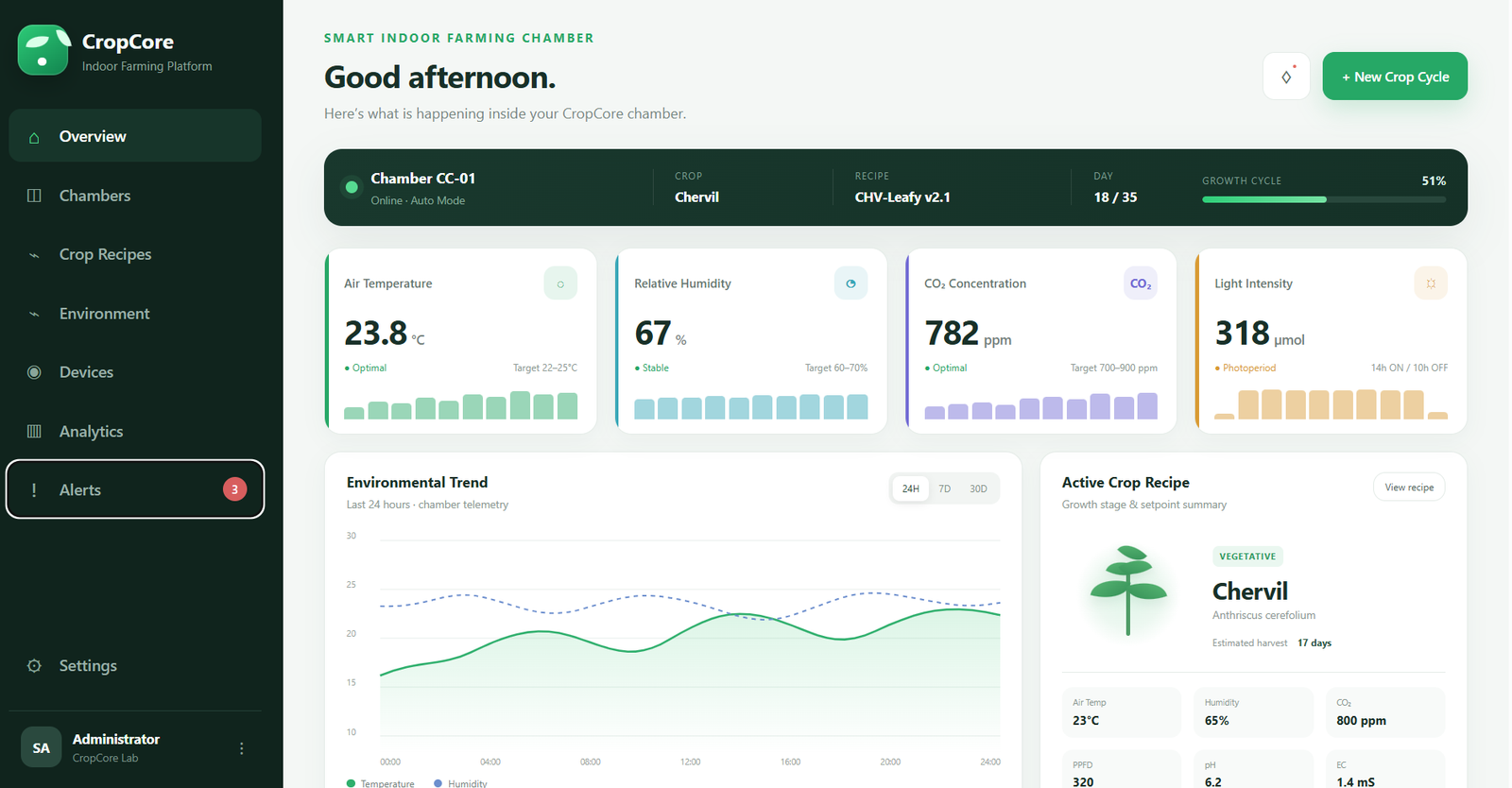
CropCore can support research teams during discovery and operators when a validated recipe moves toward repeatable production.
Controlled trials, student research, crop physiology studies, adaptation experiments, and reproducible datasets.
Compare cultivars or accessions under defined environmental conditions and document their growth response.
Develop operating recipes, validate sensors and automation strategies, and test new controlled-environment methods.
Apply validated recipes to high-value crops where consistency, traceability, and repeatable quality matter.
Start with a measurable chamber, test how a crop responds, and refine the result into a recipe that can be repeated.